Hello. I’m Gavin Edwards, the public speaker and the New York Times-bestselling author of The Tao of Bill Murray, the ’Scuse Me While I Kiss This Guy series, and Kindness and Wonder: Why Mister Rogers Matters Now More Than Ever. If you’re interested in hiring me, click here for more information.

Friday Foto: Finding Neverland

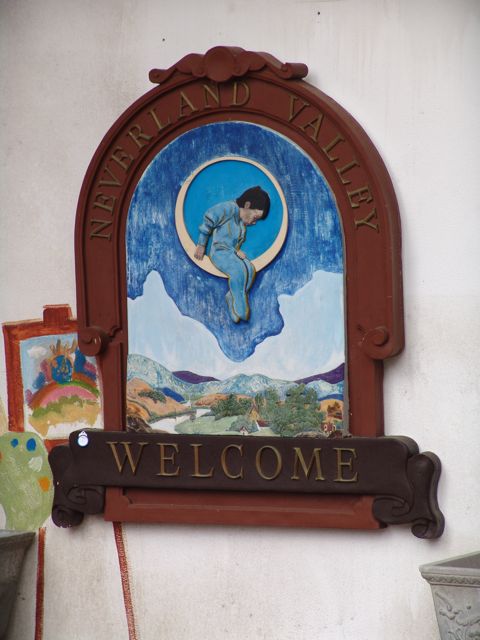
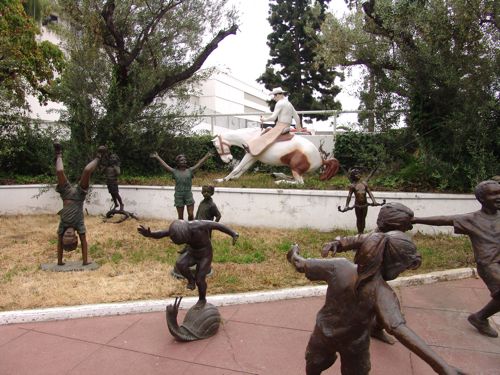
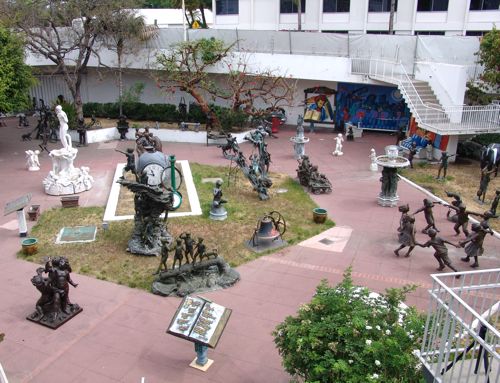
I spent the morning at the public exhibition of the contents of Michael Jackson’s Neverland ranch (for an auction that has since been cancelled–if it was ever intended to actually happen in the first place).

The visit started off kitschy and entertaining, but by the end, the whole thing just seemed like the detritus of an American tragedy.

I took approximately a kazillion photographs, of which I will share four today. (More pictures and a fuller report next week.) All are from the exhibition area that displayed the outdoors statues and artworks from the Neverland grounds. In other words, you haven’t even made it in through the front door yet.

neverland102.jpg

neverland103.jpg

neverland101.jpg

neverland104.jpg

posted 24 April 2009 in Photos. no comments yet

1988 Countdown #71: Terence Trent D’Arby, “Sign Your Name”

(New to the countdown? Catch up here.)

ttd106.jpg

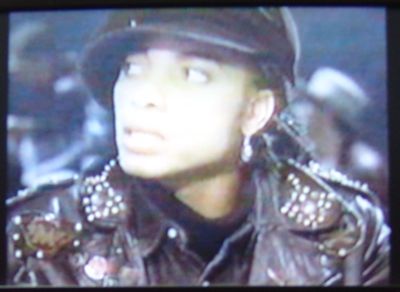
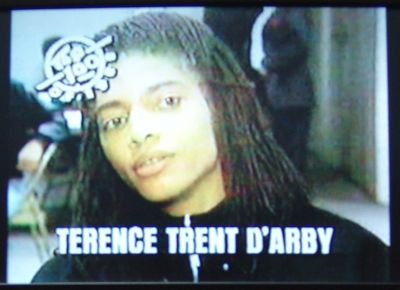
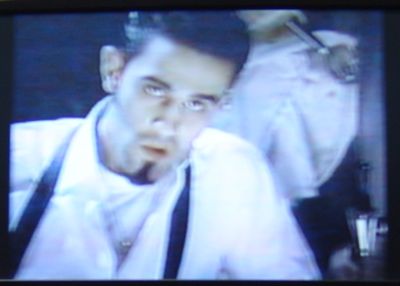
We return from the commercial break with an interview clip of Terence Trent D’Arby, looking impossibly young. He appears to be sitting in the hallway of an awards show (the background includes both a folding chair and a guy in a tuxedo). “Nowadays you can make three albums,” D’Arby says, “and you only find out on your third album that you’re crap, you know.”

The clip is so brief, it’s hard to guess what larger point D’Arby was making, but he was uncannily prophetic when it came to his own career. His debut (Introducing the Hardline According to Terence Trent D’Arby) was excellent and suggested he might be a Prince-level talent; the followup (Terence Trent D’Arby’s Neither Fish Nor Flesh) was an eclectic hodge-podge but still had flashes of brilliance; by the time of the third record (Symphony or Damn), however, it had become clear that D’Arby’s destination was actually dull middlebrow R&B. Despite changing his name to Sananda Maitreye, that’s where he’s lived since.

(Two side notes on Neither Fish Nor Flesh: (1) It always astonished me that having made a deliberately experimental and uncommercial album, D’Arby was upset that it didn’t sell. (2) I can’t think of another album title with “Nor” in it.)

ttd101.jpg

MTV cuts to Kevin Seal, who seems genuinely amused by the D’Arby soundbite. Seal informs us, “Mr. D’Arby has said that he writes most of his songs when he’s like, half-asleep and only about ten minutes, whips them right off. So he should have those next two albums done in no time at all.”

He then introduces “Sign Your Name,” the followup single to the #1 hit “Wishing Well” (which I’m sure we’ll be seeing later in this countdown). I would hazard that “Sign Your Name” is now D’Arby’s best-remembered song; I saw George Michael cover it live in the early ’90s and realized it had already become a standard. Despite its dated synth & drum machine arrangement, the track still sounds like a certified classic: D’Arby delivers a delicate yet soulful vocal, and the songwriting is worthy of Smokey Robinson.

ttd102.jpg

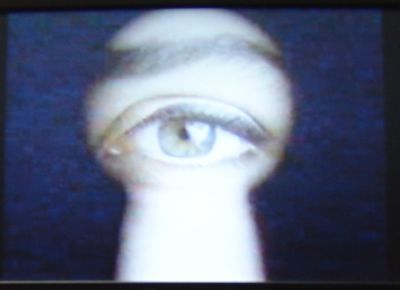
The video opens with a woman’s green eye, framed by a keyhole. “Au revoir, Terence,” she says, and we cut to her POV, looking at a sleeping Terence Trent D’Arby, and then pulling away. “Au revoir, Terence” echoes as we cut to the woman: a beautiful if severe brunette. She blows a kiss, and the music starts. The camera pulls back from the French woman to reveal that her image is being projected on D’Arby’s bed.

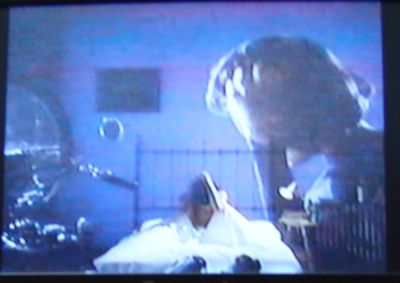
We see Frenchie walking down a staircase, holding the hand of a small girl, who drops her teddy bear. They get into what appears to be a beautiful vintage car: perhaps a Maybach. D’Arby still sleeps, his cornrows perfectly framing his face. He wakes up and discovers that he is now sharing his bed with a goodbye note, rolled up with a black ribbon. He sits up, unrolls it, and reads. Frenchie is now projected on the wall behind him. The camera pulls back to reveal D’Arby’s bedroom, which appears to be decorated with only a motorcyle. “Damn,” D’Arby thinks. “I’m having that dream again–the one where I’m in a music video.”

ttd103.jpg

Frenchie and the child have their faces pressed up against the rear window of the Maybach, looking up (presumably at D’Arby’s window, rather than an impressive piece of skywriting) as the car pulls away. In bed, D’Arby flips his hair back and holds his head, looking anguished. Frenchie, projected behind him, is also running her hand through her hair–now we know what brought them together. (If only Cher was around to act as couples counselor.)

We hit the chorus; D’Arby lip-synchs it, sitting in a reversed chair, his chin resting on his arms. He hasn’t put on a shirt yet. A different memory comes up on the projection screen: Frenchie, dancing with the child in an austerely art-directed kitchen.

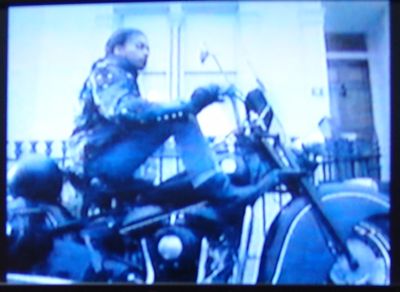
When hard times come to a man, there’s only thing to do: he’s got to ride his motorcycle. We don’t see the scene where D’Arby laboriously lugs it down the staircase–maybe he has one motorcycle for outside and another for inside? With a delicate beat tick-tocking, D’Arby saddles up, kick-starts the engine, and rolls out under a gray British sky. We get a shot of him riding down the street, proving that yes, underneath that leather jacket and that helmet, it is the actual pop star riding that vintage Indian motorcyle.

ttd104.jpg

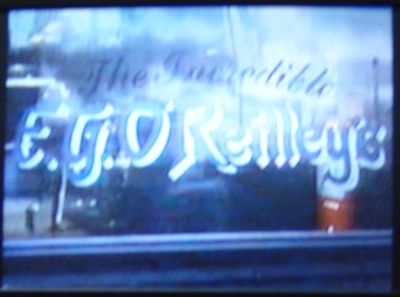
D’Arby pulls up to a pub, “The Incredible E.G. O’Reilley’s.” I think the video crew is having a little fun at D’Arby’s expense here; it’s hard to believe that the location scout didn’t realize they would be shooting a sign that, when read quickly, begins “The Incredible EGO.”

The pub is smoky and seems to be populated mostly by male models. Either they’re all out drinking exceptionally early, or D’Arby slept away half the day, which is why his woman finally left him. D’Arby sits down at the bar. Cut to a beautiful redheaded girl kissing a light-skinned black man: no, not D’Arby. We pan over to him lip-synching the chorus again, leading into “birds never look into the sun before the day is done,” one of many lyrics in this song that are evocative yet meaningless.

ttd105.jpg

The doe-eyed D’Arby nurses his drink while the male models chat and a vision of Frenchie appears behind him. A white guy with some of the worst facial hair of 1988 looks at D’Arby, puffs his cheeks, and shakes his head knowingly. D’Arby looks like he might cry. A closeup shows us the skull earring dangling from his left earlobe.

D’Arby looks like he thought it would be fun to dress up as a biker for Halloween, and so rented a puffy leather cap and an overdecorated leather jacket. It’s a good thing he didn’t go into a real biker bar, or else he’d get his ass kicked. But as he stands up, he bumps shoulders with one of the male models, who glares at him threateningly. Two other guys stand up, ready to join in the brawl. In a completely ludicrous turn of events, the shoulder-bumper then holds up his palms and backs away. I suppose this is meant to convince us of the street cred and general hardness of D’Arby, but it just invites speculation as to what could actually be happening. Is D’Arby the nephew of the bouncer? Maybe D’Arby has really bad body odor? Did he just get his pocket picked?

A brief shot of a guy with dreadlocks chalking up a cue. This seems like a good time to mention that although this video is excessively art-directed, the money was generally well-spent: it looks expensive and moody throughout, which is presumably what everyone was aiming for. And the music does the heavy lifting.

ttd107.jpg

D’Arby on his motorcyle again, riding through London, remembering better times (which we see in quick flashbacks). He parks the bike and sits on it, hoisting up his right leg, posing for the camera. We pan up to another window, where Frenchie and child are sitting, silhouetted. D’Arby purses his lips and pulls off his leather gloves, having recently been informed that “taking the gloves off” is a common idiom.

We see the child: she’s a beautiful girl, maybe six years old, and judging by her skin tone and kinky hair, she is convincingly cast as the daughter of D’Arby and Frenchie. We see that the girl’s teddy bear is strapped onto the back of D’Arby’s motorcyle. As the song climaxes with D’Arby singing, “Hey-yay-eeeyuh-yay,” we see her clutching that teddy bear. To me, the little girl’s presence is the most interesting aspect of the video. It’d have been easy enough to make this clip without the daughter, but she’s both a nice plot twist and a reminder of the consequences of all this sexual longing. But D’Arby seriously needs to childproof his loft: you don’t let a six-year-old play with a motorcycle.

The chorus repeats; D’Arby walks up behind the woman and puts his hands over her eyes (it comes off creepy rather than mysterious or sexy). As the camera circles around them, she turns to D’Arby, pushes off his motorcyle jacket, and they passionately embrace. We spin slowly around their kiss as the song fades.

“Sign Your Name” hit #4 on the Billboard pop charts. You can watch the video here.

posted 23 April 2009 in 1988. 8 comments

Like to Take a Cement Fix

For your reading pleasure on this hot Monday, an episode in celebrity medicine from The Andy Warhol Diaries:

Sunday, December 19, 1976
Went to work (magazines and newspapers for week $26). Lou Reed called and that was the drama of the day. He’d come back from a successful tour, he was a big hit in L.A., but he said Rachel had gotten kicked in the balls and was bleeding from the mouth and he wanted the name of a doctor. Lou’s doctor had looked at Rachel and said that it was nothing, that it would stop, but Lou wanted another doctor to check. I said I’d get Bianca’s. But then Lou called back and said he got Keith Richards’s doctor to come over. I told him he should take her to the hospital. I was calling Rachel “she” because she’s always in drag but then Lou calls him “he.”

posted 20 April 2009 in Excerpts. no comments yet

Friday Foto: Flipwalk #40

Marching on with the flipwalks, and this time I’m particularly pleased with the photograph. A teaser to whet your appetite:

walk40bigbite.jpg

To see the complete image, click here.

I made a few tweaks to my standard format this time. The first is that the page for flipwalk #40 has a link to a larger version of the (complete) image. I’ve been happy enough with the standard size of my photos here at Rule Forty-Two, and it works out fine when I take a picture with a strong vertical orientation (like here). But when the picture is more horizontal, too much detail gets lost and it’s always irked me. I’ll go through the flipwalk archives soon and add higher-resolution versions of some of the older photographs that have suffered from shrinkage.

The second is that I experimented with rendering my route on Google Maps (instead of my trusty Xeroxed maps). If you like or despise any of the changes, by all means say so in the comments.

posted 17 April 2009 in Photos. no comments yet

Blue Plate Crab Special

I had hoped to return to the 1988 countdown today, but it looks like that’ll be delayed another week; my apologies.

In the meantime, since Phil Spector is in the news this week, having been convicted of the murder of Lana Clarkson, may I direct you to this long, fascinating email I got from him in 2004 on the recording of “Be My Baby” (and the prevalence of crabs at Gold Star Studios)?

posted 15 April 2009 in Archives, News. no comments yet

Achtung!

I am delighted to announce that my 2006 book, Is Tiny Dancer Really Elton’s Little John?: Music’s Most Enduring Mysteries, Myths, and Rumors Revealed, has been translated into German. “Is the title all one word?” asked one friend. Alas, no, and surprisingly to me, it’s not even all German: it’s Do You Want to Know a Secret?: Die größten Geheimnisse, Mythen und Gerüchte der Rockwelt. Ask for it by name. Personally, I plan to work “Rockwelt” into conversation as often as possible from now on.

german-book-cover.jpg


I’ve had magazine articles and other short pieces of writing translated into foreign languages before, which I always find flattering and weirdly intimate. It means that somewhere, a heroic translator is poring over my prose and thinking about every single word as carefully as I did (or more). But I’ve never had a whole book in a foreign tongue, and I am humbled and awed. (My thanks to Thorsten Wortmann, who translated the book into German–and to Jana Moskito, who did the new illustrations.)

Just to prove I’m not making this up, I’m providing links to the publisher’s website, the German edition of Amazon, and the German magazines Der Spiegel and Stern. Both magazines have reviewed it, and I’m cautiously ecstatic (ecstatic because I gather that they’re big deals in Deutschland; cautiously because I can’t actually read German, so it’s possible they’re slagging me off).

posted 13 April 2009 in Buy My Stuff. no comments yet

Friday Foto: Flipwalk #39

It’s been almost two months since I posted a flipwalk; if you’re new to the project, you can catch up here.

walk39bigbite.jpg

That’s a blown-up detail from the final image; for the story of my hour-long random peregrination and the resulting picture, you can click here.

posted 10 April 2009 in Photos. no comments yet

Kurt Cobain, 1967-1994

Kurt Cobain died fifteen years ago this week.

When I heard the news, I bolted from the office of Details magazine (my then-employer) and went home to Brooklyn to find my Nirvana notebooks. I had toured around Germany with Nirvana in 1991, as Nevermind was becoming a blockbuster hit, and done another extensive interview with Cobain in Seattle just before In Utero was released. I knew that in my notes, I had contact information for people close to Cobain; I wanted to pass them on to a reporter who had recently interviewed Courtney Love; Details was putting her on a plane to Seattle to get an on-the-scene dispatch. The reporter strenuously resisted, saying that if she stayed home, Courtney would call her. Everyone in the office scoffed.

I spent a couple of hours going through every inch of my closets, while in the background, MTV played an endless loop of Nirvana. Finally, I gave up and came back without the notebooks. The next day, I found them in the office, stashed in a desk drawer. By then, the reporter was gone, on the same plane flight as representatives of Rolling Stone and the New York Times. My information didn’t help her; she came back a couple of days later, having been shut out like all the other writers who descended on Seattle. While she was gone, Courtney had left a message on her answering machine.

I wrote a personal remembrance of Cobain for the magazine, which you can read here. I’ve added the piece to the archives unedited even though there are portions of it I now find callow and naïve. (For example: I know now that Cobain was using heroin while I visited him in Seattle, and was keeping it together just enough to do his press interviews.) But my grief was genuine, and I suspect some of the details might be of interest to a new generation of readers. (I’ll add my other Nirvana articles to the archives soon.)

My memories of Cobain are complicated, for many reasons, and this piece doesn’t fully reflect my mixed emotions in 2009. But I still feel privileged that I got to spend so much time talking to him.

posted 8 April 2009 in Archives, Articles. 2 comments

Recourse to the Law

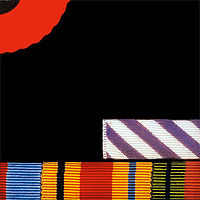
I recently wondered what album had the highest differential between the times I listened to before my high school graduation to times I listened to it after that. The answer, I decided, was Pink Floyd’s The Final Cut. It was one of the first three albums I ever owned, and was in heavy rotation in my bedroom for quite a while, but I don’t think I’ve played it even once in the past twenty years. So naturally, I needed to see how it held up.200px-thefinalcut.jpg

I was astonished to find how familiar every song was, even after two decades. It’s not a good record, but it has some lovely moments; “Southampton Dock” and the title track hold up particularly well. There are some clunker songs (“Not Now John”), but mostly, it’s a professional and bloodless disc. But then I got to the final cut on The Final Cut, “Two Suns in the Sunset,” the tale of a man driving on some British motorway who sees a nuclear explosion and spends five minutes ruminating musically on how it marks the end of civilization.

Okay, fine, I decided. I can work with it, even the overdramatic bits (“as the windshield melts and my tears evaporate”). Sure, when Roger Waters is trying to dramatize what’s been lost, he layers in a clip of a small child shouting “Daddy! Daddy!” in a fashion that’s more farcical than horrifying. But I finally gave up when Waters got to the climax of that verse, lamenting the ultimate loss that ranks even higher than the death of your loved ones:

You have no recourse to the law anymore.

What the fuck? Billions are dead, the survivors are eating dogs in the street, and you’re upset that you can’t file a lawsuit about it?

The phrase “recourse to the law,” clunky as it is, also appears earlier on the album (on “The Gunner’s Dream”), so obviously Waters was thinking about it a lot. Maybe there was nothing more important to him in 1982 than the knowledge that, if necessary, he would be able to sue David Gilmour.

posted 7 April 2009 in Tasty Bits. 5 comments

The Artist Currently Known as Prince

Prince has a new album out: another three-disc package (his fifth, by my count). My review is in the latest issue of Rolling Stone; you can also read it now on their website. A few other things Prince and Woody Allen have in common: (1) they’re short (2) they’re basketball fans (3) they were funnier earlier in their career.

posted 2 April 2009 in Outside, Reviews. no comments yet